

Is It Illegal To Not Report A Counterfeit Money
Counterfeit money is currency produced without the legal sanction of the Country or government, usually in a deliberate attempt to imitate that currency and so equally to deceive its recipient. Producing or using counterfeit money is a course of fraud or forgery, and is illegal. The business of counterfeiting money is almost equally old equally money itself: plated copies (known as Fourrées) have been found of Lydian coins, which are thought to be among the first Western coins.[1] Before the introduction of paper money, the most prevalent method of counterfeiting involved mixing base metals with pure aureate or silverish. Another form of counterfeiting is the production of documents by legitimate printers in response to fraudulent instructions. During Earth War Two, the Nazis forged British pounds and American dollars. Today some of the finest apocryphal banknotes are chosen Superdollars because of their high quality and imitation of the existent US dollar. There has been pregnant counterfeiting of Euro banknotes and coins since the launch of the currency in 2002, but considerably less than that of the United states of america dollar.[ii]

Counterfeit 100-dollar pecker, dated 1974 but probably made later. Over-stamped with "Contrefaçon" on both sides. On brandish at the British Museum, London
Some of the ill-effects that counterfeit money has on gild include[3] [four] a reduction in the value of real money; and an increase in prices (inflation) due to more money getting circulated in the economic system—an unauthorized artificial increase in the coin supply; a decrease in the acceptability of paper money; and losses, when traders are not reimbursed for counterfeit money detected past banks, fifty-fifty if information technology is confiscated. Traditionally, anti-counterfeiting measures involved including fine item with raised intaglio printing on bills which allows non-experts to easily spot forgeries. On coins, milled or reeded (marked with parallel grooves) edges are used to show that none of the valuable metal has been scraped off.
History [edit]
Counterfeiting is sufficiently prevalent throughout history that it has been called "the earth'due south second-oldest profession".[v] [vi] Coinage of money began in the region of Lydia around 600 B.C. Before the introduction of paper money, the most prevalent method of counterfeiting involved mixing base metals with pure golden or silver. A common practice was to "shave" the edges of a coin. This is known as "clipping". Precious metals collected in this way could be used to produce counterfeit coinage. A fourrée is an ancient type of counterfeit money, in which a base metal core has been plated with a precious metallic to resemble its solid metal counterpart.
When paper money was introduced in China in the 13th century, wood from mulberry trees was used to make money. To control access to the paper, guards were stationed around mulberry forests, while counterfeiters were punished by death.[7]
In the 13th century, Mastro Adamo was mentioned past Dante Alighieri as a counterfeiter of the Florentine fiorino, punished with expiry past hanging. The English language couple Thomas and Anne Rogers were convicted on fifteen October 1690 for "Clipping 40 pieces of Silvery". Thomas Rogers was hanged, drawn, and quartered while Anne Rogers was burnt live. Evidence supplied past an informant led to the arrest of the last of the English language Coiners "Male monarch" David Hartley, who was executed past hanging in 1770. The extreme forms of penalization were meted out for acts of treason against the State or Crown rather than a simple crime.
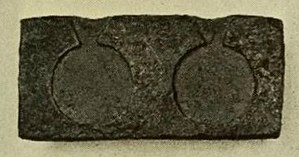
In the late eighteenth and early nineteenth centuries, Irish gaelic immigrants to London were particularly associated with the spending (uttering) of counterfeit money, while locals were more than likely to participate in the safer and more than assisting forms of currency crime, which could take place behind locked doors. These include producing the false money and selling it wholesale.[8]
Similarly, in America, Colonial paper currency printed by Benjamin Franklin and others frequently diameter the phrase "to counterfeit is death".[9] The theory behind such harsh punishments was that one who had the skills to counterfeit currency was considered a threat to the condom of the State, and had to be eliminated. Another explanation is the fact that issuing money that people could trust was both an economic imperative, besides as a (where applicative) Royal prerogative; therefore, counterfeiting was a crime against the state or ruler itself, rather than confronting the person who received the faux money. Far more than fortunate was an before practitioner of the same art, active in the fourth dimension of Emperor Justinian. Rather than executing Alexander the Barber, the Emperor chose to employ his talents in the authorities's own service.[ citation needed ]
Nations take used counterfeiting equally a means of warfare. The idea is to overflow the enemy's economy with fake banknotes then that the existent value of the money plummets. Swell U.k. did this during the American Revolutionary War to reduce the value of the Continental Dollar. The counterfeiters for the British were known every bit "shovers", presumably for the ability to "shove" the fake currency into circulation. Two of the most well-known shovers for the British during the Revolutionary War were David Farnsworth and John Blair. They were caught with 10,000 dollars in counterfeits when arrested.[10] George Washington took a personal interest in their case and fifty-fifty chosen for them to be tortured to discover further information. They were somewhen hanged for their crimes.[11]
During the American Ceremonious State of war, the Confederate States dollar was heavily counterfeited by private interests on the Union side, frequently without the sanction of the Union government in Washington. The Confederacy's access to modern press technology was limited, while many Northern-made imitations were printed on high-quality banknote paper procured through extralegal means. As a result, counterfeit Southern notes were oftentimes equal or fifty-fifty superior in quality compared to genuine Amalgamated coin.
In 1834, counterfeit copper coins manufactured in the United States were seized from several ships with American flags in Brazil. The practice seemed to finish after that.[12]
Instances [edit]
A class of counterfeiting is the production of documents by legitimate printers in response to fraudulent instructions. An example of this is the Portuguese Bank Note Crunch of 1925, when the British banknote printers Waterlow and Sons produced Banco de Portugal notes equivalent in value to 0.88% of the Portuguese nominal Gross Domestic Product, with identical serial numbers to existing banknotes, in response to a fraud perpetrated by Alves dos Reis. Similarly, in 1929 the issue of postage stamps jubilant the millennium of Iceland's parliament, the Althing, was compromised by the insertion of "1" on the print social club, before the authorized value of stamps to be produced (see Postage stamp stamps and postal history of Iceland).[ citation needed ]
In December 1925 a high-contour apocryphal scandal came to lite, when three people were arrested in kingdom of the netherlands while attempting to disseminate forged French 1000-franc bills which had been produced in Hungary. Subsequent investigations uncovered show that plot had received widespread support in Hungarian and German language nationalist circles including the patronage of loftier ranking military and civilian officials. Twenty-four of the conspirators were tried in Budapest in May 1926. Most received light sentences in what is believed to have been a deliberate comprehend upward by Hungarian Prime Minister István Bethlen. The affair facilitated the adoption of the International Convention for the Suppression of Counterfeiting Currency in April 1929 and formalized the part of the International Criminal Police Commission.[13] [14]
During Earth War II, the Nazis attempted to implement a like program (Performance Bernhard) confronting the Allies. The Nazis took Jewish artists to the Sachsenhausen concentration military camp and forced them to forge British pounds and American dollars. The quality of the counterfeiting was very good, and it was nigh impossible to distinguish between the existent and fake bills. The Nazis were unable to carry out planned aerial drops of the counterfeits over Britain, so about notes were disposed of and not recovered until the 1950s.[xv]
Today some of the finest apocryphal banknotes are called Superdollars considering of their high quality, and likeness to the real U.s.a. dollar. The sources of such supernotes are disputed, with North Korea being vocally accused by US government.[16] The amount of counterfeit United States currency is estimated to be less than $3 per $10,000, with less than $3 per $100,000 existence difficult to detect.[17]
At that place has been a rapid growth in the counterfeiting of euro banknotes and coins since the launch of the currency in 2002. In 2003, 551,287 fake euro notes and 26,191 bogus euro coins were removed from EU apportionment. In 2004, French police seized fake €10 and €20 notes worth a total of effectually €1.8 million from two laboratories and estimated that 145,000 notes had already entered circulation.[ commendation needed ]
In the early on years of the 21st century, the United States Secret Service has noted a substantial reduction in the quantity of forged U.Due south. currency, as counterfeiters plough their attention towards the euro.[ citation needed ]
As a result of their rarity, gold and silvery certificates have sometimes been erroneously flagged as counterfeits in the Us when they have, in fact, been 18-carat.[18] Due to the fact that these banknotes carry pregnant numismatic value and are sought subsequently by collectors, counterfeit examples have surfaced on eBay via unscrupulous sellers.[19]
A batch of counterfeit A$fifty and A$100 notes was released into the Australian city of Melbourne in July 2013. As of July 12, 2013, twoscore reports had been fabricated between the northern suburbs of Heidelberg and Epping. Law spokespersons explained to the public in media reports that the currency notes were printed on paper (Commonwealth of australia introduced polymer banknotes in 1988) and could be hands detected by scrunching up the annotation or tearing it. Additionally, the clear window within the notes was besides an easy mode to place fake versions, as the "window appears to accept been cut out with two clear plastic pieces stuck together with stars placed in the middle to replicate the Southern Cantankerous". Police besides revealed that false notes had been seized in June 2013 in Melbourne'due south eastern and western suburbs.[20] According to the Australian RBA figures, during 2014–15, the number of counterfeit $l currency detected in circulation has more doubled from the previous yr, and more than 33,000 faux notes were removed from circulation. The officials believe this likely a fraction of the number of fake currencies currently flooding through in Victoria and NSW states.[21] On 31 May 2016, the ACT police have warned people to keep an eye out for fake $50 notes, which is circulating throughout Canberra in recent months. The officers take been chosen out to more than 35 businesses over the by two months in connection to counterfeit $50 notes.[22] Australian Federal Police have charged two persons alleging to have produced $sixteen,465 notes of counterfeit currency and charged them with various offences nether the Crimes (Currency) Act 1981. The police said that while Australian notes are hard to counterfeit, featuring many security features, they yet urged people to have a close expect each time they spend cash.[23]

Anti-counterfeit money sign and examples of counterfeit notes received by a noodle shop in Kunming, Yunnan, Communist china.
Effects on society [edit]
Some of the ill-effects that apocryphal money has on society include:[3] [iv]
- Companies are not being reimbursed for counterfeits. This has led to companies losing buying power.[24] As such, there is a reduction in the value of real coin.
- Increment in prices (inflation) due to more money getting circulated in the economy—an unauthorized artificial increase in the money supply.[ citation needed ]
- A decrease in the acceptability (satisfactoriness) of money—payees may demand electronic transfers of real coin or payment in some other currency (or even payment in precious metals such as gilt).[ commendation needed ]
At the same time, in countries where paper money is a small fraction of the total money in circulation, the macroeconomic effects of counterfeiting of currency may not be meaning. The microeconomic furnishings, such as confidence in the currency, however, may be large.[25]
Anti-counterfeiting measures [edit]
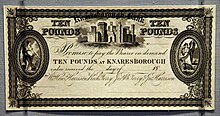
Proof banknote, 10 pounds, Knaresborough Erstwhile Depository financial institution, 1800s. Details, similar the decorative frame and image of Knaresborough Castle as well as figures of Fortune and Plenty at left and right on this notation, were intended to forbid forged notes from existence fabricated. On display at the British Museum in London
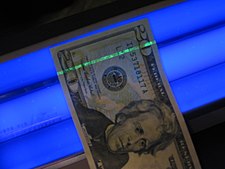
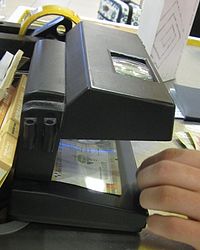
Pecker inspection device in use in Peru, showing magnifying drinking glass for inspection of item and lit upwards security strip.
Traditionally, anti-counterfeiting measures involved including fine detail with raised intaglio printing on bills which would allow non-experts to easily spot forgeries. On coins, milled or reeded (marked with parallel grooves) edges are used to testify that none of the valuable metal has been scraped off. This detects the shaving or clipping (paring off) of the rim of the coin. However, information technology does not find sweating, shake coins in a bag, and collect the resulting grit. Since this technique removes a smaller amount, it is primarily used on the most valuable coins, such as gold. In early paper coin in Colonial Due north America, one creative ways of deterring counterfeiters was to print the impression of a leaf in the beak. Since the patterns found in a leafage were unique and complex, they were nearly incommunicable to reproduce.[9]
In the late twentieth century, advances in computer and photocopy engineering science fabricated it possible for people without sophisticated grooming to re-create currency easily. In response, national engraving bureaus began to include new, more sophisticated anti-counterfeiting systems such as holograms, multi-colored bills, embedded devices such as strips, raised printing, microprinting, watermarks, and color-shifting inks whose colors changed depending on the bending of the light, and the use of design features such as the "EURion constellation" which disables modern photocopiers. Software programs such as Adobe Photoshop have been modified by their manufacturers to obstruct manipulation of scanned images of banknotes.[26] In that location too exist patches to counteract these measures.
Recently, there has been a discovery of new tests that could exist used on U.Due south. Federal Reserve Notes to ensure that the bills are authentic. These tests are done using intrinsic fluorescence lifetime. This allows for the detection of counterfeit money because of the significance in divergence of fluorescence lifetime when compared to authentic coin.[27]
For U.Due south. currency, anti-counterfeiting milestones are as follows:
- 1996 $100 bill gets a new design with a larger portrait
- 1997 $50 bill gets a new design with a larger portrait
- 1998 $twenty bill gets a new pattern with a larger portrait
- 2000 $10 bill and $5 bill go a new design with a larger portrait
- 2003 $20 pecker gets a new design with no oval around Andrew Jackson'due south portrait and more colors
- 2004 $50 bill gets a new design with no oval around Ulysses S. Grant'south portrait and more colors
- 2006 $x bill gets a new pattern with no oval effectually Alexander Hamilton'due south portrait and more colors
- 2008 $5 bill gets a new design with no oval effectually Abraham Lincoln'south portrait and more than colors
- 2010 $100 beak gets a new design with no oval around Benjamin Franklin's portrait and more colors; along with the inclusion of the new "3D security ribbon"
The redesigned $100 bill was unveiled on April 21, 2010, and the Federal Reserve Board was to begin issuing the new neb on Feb ten, 2011, simply the release was delayed until October 2013.[28]
The Treasury had made no plans to redesign the $v bill using colors but recently reversed its decision after learning some counterfeiters were bleaching the ink off the bills and printing them as $100 bills. The new $x nib (the design of which was revealed in late 2005) entered apportionment on March 2, 2006. The $1 bill and $2 pecker are seen by about counterfeiters as having too low a value to counterfeit, and and so they have non been redesigned as ofttimes as higher denominations.
In the 1980s, counterfeiting in the Republic of Ireland twice resulted in sudden changes in official documents: in November 1984, the £1 stamp postage, too used on savings cards for paying television licences and telephone bills, was invalidated and replaced by another design at a few days' discover, considering of widespread counterfeiting. After, the £20 Cardinal Bank of Ireland Serial B banknote was speedily replaced because of what the Finance Minister described equally "the involuntary privatization of banknote printing".[29]
In the 1990s, the portrait of Chairman Mao Zedong was placed on the banknotes of the People's Republic of China to combat counterfeiting, every bit he was recognised ameliorate than the generic designs on the renminbi notes.
In 1988 the Reserve Bank of Australia released the world'due south first long-lasting and counterfeit-resistant polymer (plastic) banknotes with a special Bicentennial $10 annotation outcome. Later on problems with this neb were discovered and addressed, in 1992, a problem-gratis $v note was issued. In 1996 Australia became the first country to have a full serial of circulating polymer banknotes.[30] On three May 1999, the Reserve Bank of New Zealand started circulating polymer banknotes printed by Note Printing Commonwealth of australia Limited.[31] The engineering science adult is now used in 24 countries.[32] As of 2009, Note Press Australia was press polymer notes for 18 countries.[33]
The Swiss National Bank had a reserve series of notes for the Swiss franc in case widespread counterfeiting were to take place; this was discontinued in the mid-1990'south with the introduction of the 8th serial of banknotes.
Penalties past state for creating counterfeit money [edit]
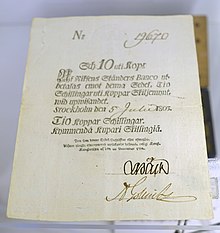
A Swedish ten Riksdaler banknote from 1803, stating that counterfeiters will exist hanged.
| Countries and areas | Maximum imprisonment and other penalties | ||
|---|---|---|---|
| Canada | 14 years[34] | ||
| Mainland china, People's Republic of | Lifetime,[35] minimum iii years, with the fine of l,000 to 500,000 yuan renminbi[36] | ||
| French republic | xxx years, with the fine of €450,000[37] | ||
| Germany | 15 years[38] | ||
| Hong Kong | 14 years[39] | ||
| Italy | 12 years and fine up to €3,098 [40] | ||
| Japan | Lifetime, minimum 3 years[41] | ||
| Korea, South | Lifetime, minimum 2 years[42] | ||
| Macau | 12 years, minimum ii years[43] | ||
| The Netherlands | 9 years, with a fine up to €67,000[44] | ||
| Philippines | 12 years, minimum vi years[45] | ||
| Poland | 25 years, minimum 5 years[46] | ||
| Portugal | 12 years, minimum 3 years (if bills),[47] 2 years, minimum 240 days (if coins)[48] | ||
| Singapore | seven years, with the fine[49] | ||
| Taiwan, Commonwealth of China | Lifetime in extreme example, minimum 5 years, with possible fine[fifty]
| ||
| United Kingdom | 10 years, with the fine with or in lieu of imprisonment[51] | ||
| United States | 20 years, with the fine with or in lieu of imprisonment[52] | ||
| Zambia | Lifetime,[53] with possible fine[54] | ||
| Colombia | iii to eight years of prison depending on the amount of counterfeit money possessed. |

Notable counterfeiters [edit]
- Peter Alston was the late-18th-century and early-19th-century counterfeiter and river pirate, who is believed to be Piddling Harpe'southward associate and partner in the murder of notorious outlaw leader Samuel Bricklayer in 1803
- Philip Alston was an 18th-century counterfeiter both before and after the American Revolution in Virginia and the Carolinas before the war, and subsequently in Kentucky and Illinois after.
- Anatasios Arnaouti, a British counterfeiter of more than than £2.5 million in false money, was sentenced in 2005.
- Edward Bonney, an alleged counterfeiter in northern Indiana who escaped to Nauvoo, Illinois, was a bounty hunter and amateur detective who posed as a counterfeiter to apprehend the murderers of Colonel George Davenport and infiltrate the Midwestern Banditti of the Prairie.
- Abel Buell, an American colonialist and republican who went from altering v-pound note engraving plates to publishing the beginning map of the new Us created by an American.
- Mary Butterworth, a counterfeiter in colonial America.
- William Chaloner, a British counterfeiter, was convicted by Sir Isaac Newton and hanged on sixteen March 1699.
- Mike DeBardeleben, a bedevilled kidnapper, rapist, and suspected serial killer, was sent to prison for counterfeiting the $20 neb.
- Alves dos Reis, who by the end of 1925 had managed to introduce escudo banknotes worth £1,007,963 at 1925 exchange rates into the Portuguese economy, which was equivalent to 0.88% of Portugal's nominal Gdp at the fourth dimension.
- John Duff was a counterfeiter, hunter, and soldier who served in George Rogers Clark's campaign to capture the Illinois country, for the Patriot American side, during the Revolutionary State of war.
- Eric "Klipping" V, the king of Kingdom of denmark (1259–1286). The king's nickname refers to "clipping" of the money.
- David Farnsworth was a British Loyalist American counterfeiter and spy in the American Revolutionary War. He was hanged for his crimes afterward George Washington had taken a personalised interest in his case.[10]

Francis Greenway on the first Australian 10 dollar annotation, perhaps the but convicted forger in the earth depicted on a banknote.
- Francis Greenway was an English-born architect transported to Australia in 1814 every bit a captive for the crime of forgery, where he rose as a prominent planner of public buildings. He later posthumously became probably the simply forger to exist depicted on a banknote, the Australian $10.[55]
- "King" David Hartley was the leader of the Cragg Vale Coiners of rural 18th-century England. Producing faux gold coins, he was somewhen captured and hanged at Tyburn near York on April 28, 1770, and cached in the village of Heptonstall, Due west Yorks. His brother, Isaac, escaped the government and lived until 1815.
- Thomas McAnea, also known as Hologram Tam, a Scottish master counterfeiter regarded as i of the near skillful in Europe with regard to banknote security holograms.[56]
- Emerich Juettner, documented in Mister 880, was perchance the longest uncaught counterfeiter in history.[57] For ten or more years, he eluded authorities authorities while he printed and spent fake $1 bills in his New York neighborhood.[58]
- Catherine Murphy, convicted of coining in 1789 and was the final woman to endure execution past burning in England.
- John A. Murrell, a near-legendary bandit, operating in the United States forth the Mississippi River in the mid-nineteenth century. Convicted for his crimes in the Excursion Court of Madison County, Tennessee, Murrell was incarcerated in the Tennessee Land Penitentiary, modeled after the Auburn penal system, from 1834 to 1844.
- King Philip the Fair of French republic (1268–1314) caused riots and was known as "the counterfeiter male monarch" for emitting coinage that was debased compared to the standards that had been prevalent during the half-century previous to his reign.
- Sturdivant Gang, a multi-generational group of American counterfeiters whose criminal activities took place over a 50-yr period from Colonial Connecticut to the Illinois frontier.
- Samuel C. Upham, the first known counterfeiter of Confederate money during the American Civil War. His activities began or became known in early on July 1862.
- Wesley Weber, imprisoned in 2001 for counterfeiting the Canadian ane-hundred-dollar beak.
- Arthur Williams, imprisoned in 2007 for counterfeiting the United States one-hundred-dollar bill.
Coin art [edit]
Money art is a subject related to counterfeiting that incorporates currency designs or themes. Some of these works of art are similar enough to actual bills that their legality is in question. While a counterfeit is made with deceptive intent, money art is non; notwithstanding, the law may or may not differentiate between the two. J. S. Thou. Boggs was an American artist best known for his hand-drawn, ane-sided copies of US banknotes, which he sold for the face value of the note.[ citation needed ]
Parodies of banknotes, frequently produced for humorous, satirical or promotional purposes, are called 'skit notes'.[59] [60] (The term 'skit notation' has been used since around the mid-19th century. Prior to that, the term 'flash notation' was used.[61] [62])
The street artist Banksy is known for making ten-pound notes that feature Princess Diana's portrait in place of the Queen, while "Banking concern of England" is replaced by "Banksy of England". The artist's original intent was to throw them off a building, but after some of the notes were dropped at a festival, he discovered that they could pass for legal tender and changed his listen. As of 2012, Banksy is however in possession of all one hundred million pounds' worth of the currency.[63]
In 2006, American artist Jack Daws hired metalsmiths to brand a mold of a 1970 U.S. penny and cast it in 18-karat gilded. He then hired another metalsmith to copper-plate it, after which it looked like an ordinary penny. On March 28, 2007, Daws intentionally put the "penny" in circulation at Los Angeles International Airport (LAX). The sculpture was discovered in Brooklyn two-and-a-half years later past Jessica Reed, a graphic designer and money collector, who noticed information technology while paying for groceries at a local store. Reed eventually communicated with Daws' Seattle art dealer, the Greg Kucera Gallery, and Daws confirmed that she had discovered the Counterfeit Penny sculpture.[64]
Preparation money [edit]
In May 2017, Australian currency training notes (used in-firm by Chinese banks in the training of banking concern tellers) were circulated briefly in Darwin, Northern Territory, with seven cases reported by the Northern Territory Police of notes beingness offered and taken as existent money. The $100 (Australian dollar) notes had Chinese language characters printed on them only otherwise had the colour and experience of existent notes, and the Chinese characters can be disguised when the notation is folded. They had been sold through eBay, with the disclaimer of non existence for circulation. China besides has an equivalent $l (U.South. dollar) "training money", that has previously appeared in the The states.[65]
Run into likewise [edit]
- Copyright infringement
- Counterfeit banknote detection pen
- Federal Bureau of Investigation
- International Convention for the Suppression of Counterfeiting Currency
- Money laundering
- Organized criminal offence
- Russian mafia
- Triad (organized criminal offence)
- Money
- Digital currency
- World currency
References [edit]
- ^ "A Case for the World's Oldest Coin". Retrieved 29 January 2013.
- ^ "Counterfeiting statistics for several currencies". Itsamoneything.com. 9 June 2012. Retrieved 2014-09-21 .
- ^ a b "Counterfeiting of American Currency". p. 13. Archived from the original on 2007-06-14. Retrieved 2007-06-12 .
- ^ a b "Counterfeit Money, Who Takes the Hit?". William F Hummel. Archived from the original on 2007-06-16. Retrieved 2007-06-12 .
- ^ Young, Michael. "Learn well-nigh the world of counterfeiting from one who lived at that place." Dallas Morning News, (TX) fifteen July 2009: Paper Source Plus. Web. 8 Dec. 2012.
- ^ Van Riper, Frank. "Counterfeiting." Sabbatum Evening Post 250.7 (1978): 42-44. Academic Search Premier. Spider web. 8 Dec. 2012.
- ^ Grant Robertson. "Funny money: How counterfeiting led to a major overhaul of Canada's coin". The Globe and Post . Retrieved 3 Dec 2011.
- ^ Crymble, Adam (2017-02-09). "How Criminal were the Irish? Bias in the Detection of London Currency Crime, 1797-1821". The London Journal. 43: 36–52. doi:x.1080/03058034.2016.1270876.
- ^ a b "Counterfeit notes". Librarycompany.org. Retrieved 2012-ten-xviii .
- ^ a b Counterfeiting In Colonial America, By Kenneth Scott. p. 258.
- ^ A Fiscal History of the The states, By Jerry Westward. Markham. p. 66.
- ^ Rio Grande do Sul, Assembleia Legislativa (1998). "Estados Unidos due east Rio Grande - Negócios no Século XIX - Despachos dos Cônsules Norte-Americanos no Rio Grande do Sul 1829/1941". Porto Alegre: Assembleia Legislativa do Estado practise RS. p. 60. (in English language and Portuguese)
- ^ Klay, Andor (1974). "Hungarian Counterfeit Francs: A Example of Mail service-World War I Political Demolition". Slavic Review. 33 (1): 107–113. doi:ten.2307/2495329. JSTOR 2495329.
- ^ Petruccelli, David (2016). "Banknotes from the Underground: Counterfeiting and the International Gild in Interwar Europe". Journal of Contemporary History. 51 (3): 507–530. doi:x.1177/0022009415577003. S2CID 156881357.
- ^ Malkin, Lawrence "Krueger's Men: The Secret Nazi Counterfeit Plot and the Prisoners of Block 19" (2006) ISBN 0-316-05700-2 ISBN 978-0-316-05700-4
- ^ Holton, Chuck (August 29, 2010). "Distributing Apocryphal Currency: An Human action of State of war?". CBN. Retrieved March 25, 2013.
- ^ Ruth Judson and Richard Porter (ane March 2010). "Estimating the Volume of Counterfeit U.South. Currency in Circulation Worldwide: Information and Extrapolation" (PDF). Chicagofed.org. Retrieved 2012-ten-18 .
- ^ "This Is NOT a Counterfeit Bill". finance.yahoo.com . Retrieved 2019-04-11 .
- ^ Cho, Stephanie. "How to Cosign Older Banknotes". blog.fraudfighter.com . Retrieved 2019-04-11 .
- ^ Thomas O'Byrne (11 July 2013). "Police warn on counterfeit cash". The Age . Retrieved 12 July 2013.
- ^ The Sydney Morning Herald (28 February 2016). "Australia flooded with simulated $fifty notes so proficient they fool banks". smh.com.au . Retrieved 28 February 2016.
- ^ ABC News (31 May 2016). "Fake $50 notes circulating throughout Canberra, ACT constabulary warn". abc.net.au . Retrieved 31 May 2016.
- ^ AFP Facebook page (ii September 2016). "Had a close look at your cash lately?".
- ^ "Money, Imitation Coin, & Sound Money".
- ^ "Counterfeit Banknotes" (PDF). Parliamentary office of Science and Tech., United kingdom of great britain and northern ireland. Retrieved 2017-06-16 .
- ^ "Photoshop CS5: Photoshop and CDS". Adobe. Retrieved 2012-ten-eighteen .
- ^ Chia, Th and Levene MJ. "Detection of counterfeit U.S. newspaper coin using intrinsic fluorescence lifetime". Opticsinfobase.org.
- ^ Marking Glassman (8 Oct 2013). "These New $100 Bills Are Going to Be Huge Overseas". BloombergBusinessweek. Bloomberg L.P. Retrieved 11 November 2013.
- ^ "Series C (1992/96 – 2000) Famous Irish Historical Figures". Central Bank of Ireland.
- ^ "Plastic banknotes - Australia Innovates". Powerhouse Museum. 1993-10-28. Retrieved 2012-x-eighteen .
- ^ "New Zealand'southward banking concern notes". Rbnz.govt.nz. 1999-05-03. Retrieved 2012-10-eighteen .
- ^ "Guardian™: Facts and Figures". CCL Secure . Retrieved viii October 2020.
- ^ "Polymer Banknotes Printed past Note Printing Australia". Note Printing Australia. Archived from the original on 26 April 2009.
- ^ Due south 449 of the Criminal Code, RSC 1985, c C-46, makes counterfeiting money an indictable offence.
- ^ "中华人民共和国刑法修正案(九)" [People's Republic of Cathay Criminal Constabulary Amendment]. chinalawtranslate.com. September one, 2015.
- ^ Article 170 of the Criminal Constabulary of the People's Republic of China Archived 2016-08-29 at the Wayback Machine
- ^ (in French) Article 442-1 of the Penal Code
- ^ "§ 146 StGB - Einzelnorm" [German Criminal Lawmaking, Paragraph 146]. www.gesetze-im-internet.de.
- ^ "Hong Kong e-Legislation". www.elegislation.gov.hk.
- ^ "Fine art. 453 codice penale 2020 - Falsificazione di monete, spendita e introduzione nello Stato, previo concerto, di monete falsificate" [Italian Penal Lawmaking, Commodity 453]. Brocardi.it.
- ^ "Counterfeit 500-yen coins circulating in Tokai". Japan Today. August vii, 2012. Retrieved April 19, 2020.
- ^ Article 207 of Criminal Act
- ^ (in Portuguese) Article 252 of Penal Lawmaking
- ^ Dutch penal lawmaking title X
- ^ Philippine Republic Act No. 9105, Section 11
- ^ Polish penalisation code article 310
- ^ Portuguese penalisation code, commodity 262
- ^ Portuguese penalty lawmaking, article 263
- ^ Section 231 of Penal Lawmaking (Chapter 224)
- ^ "Penal Act of Offenses Against National Currency: Article three". Laws & Regulations Database of The Republic of Red china. Ministry of Justice (Taiwan). 2011-06-29. Retrieved 2016-09-07 .
- ^ "Forgery and Counterfeiting Act 1981".
- ^ Fraudulent creation or amending of Usa currency is an offense punishable past xviii U.Southward.C. § 471.
- ^ Section 348 of the Penal Code Act, Affiliate 87 of the Laws of Zambia
- ^ Department 26(3) of the Penal Code Human action, Chapter 87 of the Laws of Republic of zambia
- ^ Broadbent, James; Hughes, Joy (1997). Francis Greenway Architect. Glebe, Northward.S.Westward.: Historic Houses Trust of New Due south Wales.
- ^ Reid, Melanie (3 October 2007). "Hologram Tam's banknote scam could accept spooked the banks". The Times. London. p. 13.
- ^ "Dine' Pride :: View topic - Bismarck Counterfeit Case". Dinepride.com. Retrieved 2012-x-18 .
- ^ "History Unwrapped". American Vision. April 2005. Archived from the original on May 12, 2008.
- ^ Interacting with Print: Elements of Reading in the Era of Print Saturation. 2019-02-08. ISBN9780226469287.
- ^ "Anti-Brexit parody banknotes are added to the British Museum'south collection". Dazed. August 10, 2019.
- ^ "THE BRITISH NUMISMATIC Journal PDF Gratuitous Download". hobbydocbox.com.
- ^ 'They are Exactly as Depository financial institution Notes are': Perceptions and Technologies of Depository financial institution Annotation Forgery During the Bank Brake Period, 1797 - 1821, Jack Mockford, University of Hertfordshire, 2014, https://uhra.herts.ac.uk/handle/2299/15308#
- ^ Interview with Banksy from the Picture show "Exit Through the Souvenir Shop", around 0:37:00
- ^ 8. Lee, Jennifer. (November 4, 2009) Brooklyn Woman Finds Counterfeit Penny Made of Gilt New York Times.
- ^ Chinese banking company's 'Australian grooming money' used every bit 18-carat $100 notes, Tom Maddocks, ABC News Online, 2017-05-09
External links [edit]
 Media related to Counterfeit money at Wikimedia Commons
Source: https://en.wikipedia.org/wiki/Counterfeit_money
Posted by: snyderyestan.blogspot.com
0 Response to "Is It Illegal To Not Report A Counterfeit Money"
Post a Comment